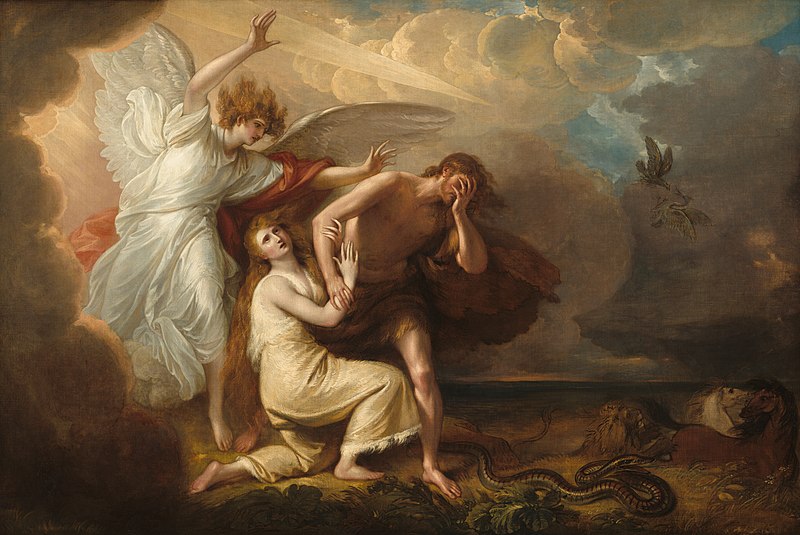

Not-self and free-will condition human existence. We learn with Existential-Buddhism that true happiness and freedom are found with self-control and morality.
In his masterwork, Being and Nothingness, the existential philosopher Jean Paul Sartre states:
We have shown that freedom and the for-itself’s being are just one and the same: human reality is free precisely to the extent to which it has its own nothingness to be. (Being and Nothingness, pg. 594)
It is because consciousness is not anything that it is free to become anything. Not-self and free will are the two sides of the same coin.
We have already shown that the Nothingness is the Not-self of Buddhism. The Buddha found that the correct elucidation of the pure knowing awareness can only be expressed negatively.
This freedom in being nothing also conditions our suffering. Because we constantly seek to define our being as something some object that we can never be. As Satre points out:
Thus this pure subject whom I am unable, by definition, to know—i.e., to posit as an object—is always there, out of reach and without distance, when I try to grasp myself as an object. (Being and Nothingness, pg. 369)
We also discussed in the article on “Kant’s Moral Law” that this unconditioned mind conditions our need for morality. This is because we are free to be as good or as evil as we want. The philosopher Emmanuel Kant found that freedom and morality reveal each other:
It is therefore the moral law, of which we become directly conscious. . . that first presents itself to us, and leads directly to the concept of freedom. . . Thus the moral law expresses nothing else than the autonomy of the pure practical reason. (Critique of Practical Reason, pg. 25-27).
Pure practical reason is a decision to act morally not based by any desire. We decide to be moral out of pure free will.
Suffering is the primordial price we pay for our freedom and self-consciousness. As Sartre solemnly states:
I am condemned to exist forever beyond my essence, beyond motives and reasons for my action: I am condemned to be free. In other words, we cannot find any limits to my freedom other than itself or, alternatively, that we are not free to cease to be free. (Being and Nothingness, pg. 577)
We bear the gift of free will but most of us are not free. But most of us are not free. Most of the suffering of humanity is caused by the ignorance of what brings about true happiness. We bring suffering to each other through our wanton appetites. We squander our freedom chasing desires that can never bring lasting happiness. We end up chained to our cravings.
The Buddha found the way back to freedom by abandoning desires and realizing the Unconditioned. He pointed to the unconditioned awareness with the Not-self doctrine. The Eightfold Path is the method to achieve it.