
What is Materialism
Materialism is a metaphysical doctrine that asserts that physical matter is the fundamental substance of the universe. Consciousness or mind are secondary or dependent phenomena.
Many Buddhist schools expound that there is no self, soul, or individual that constitute a person. They claim that consciousness or mind is the result of interdependent phenomena.
So, is Buddhism a type of Materialism?
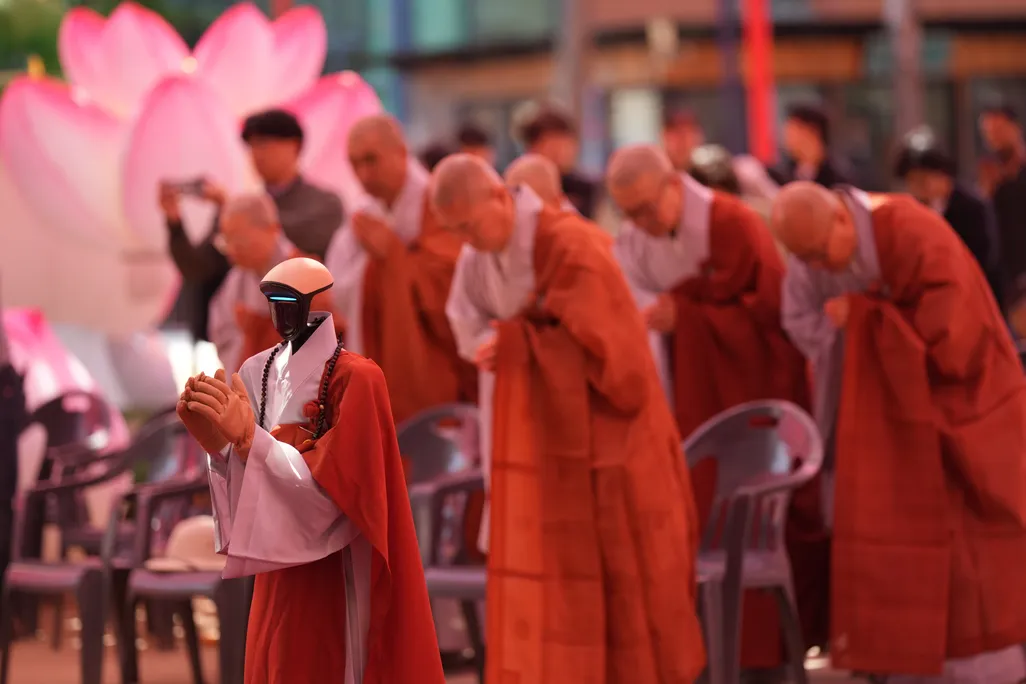
Recently, a robot named Gabi was ordained as an honorary Buddhist monk of the Jogye order of South Korea. The aim was apparently to integrate A.I. and so making Buddhism more accessible to a younger generation.
While this gesture may seem harmless, even jovial, it brings to the fore a principle that is fundamental to the understanding and practice of Buddhism: what does it mean to be self-conscious?
It is a question pertinent not only to Buddhism but to the contemporary understanding of intelligence.
More explicitly, what does it mean to be human?
Existential-Buddhism is about this very question.
The problem with robots
A robot, or computer, is only recorded intelligence. It is a much more complex version of a CD player. In this sense, ordaining a robot as a monk is like applauding a CD player. No matter how human-like a robot may be, it would be playing back what it is programmed to do.
Could a robot desire and suffer, not just act like it? Would it fear death?
Are human beings just fleshed robots? Are we just electricity, water, minerals, cells?
Is our suffering, hoping, fearing, loving only programs created by nature? Is being human an illusion? Or is self-consciousness, human awareness, transcendent?
Are we robots?
What would the difference between Gabi and an Enlightened monk. Both lack self-identity. Gabi because it was made without one and the monk because he (or she) is aware that the idea of self is a creation. Could Gabi be Enlightened?
To be aware of being Enlightened, Gabi would have to know that it was not Enlighted before. But to know this, it would first need to know desire and suffering. It would have to know itself as lacking. Then it would have to meditate and come to realize the emptiness of desire and the letting go of desire.
But this would be impossible for a machine to do because awareness is not programable. The self that is programable is the mundane self that the Enlightened monk knows as not-self, as an illusion.
The One-that-knows is the profound mystery of human existence. This is what I call Pure Awareness.
Human life on Earth is how consciousness becomes self-aware, an individual, through suffering existence.
The real illusion
Gabi the monk is an illusion. A robot cannot be a monk any more than a CD player can be a musician. But Gabi does point out that there is more to being human than just accumulating knowledge, than accumulating ones and zeros.
It is the knowing that we know, the awareness, that is the great mystery of our existence. This Pure Awareness is what is realized with Enlightenment.
So, is Buddhism materialism?
Humans are not fleshed robots. If we were only interdependent phenomena, if there was not a self-aware being, then everything else would be an illusion as well, including suffering and Enlightenment. Buddhism would be an empty illusion.
What the Buddha denied was the idea of a self or the idea of a soul. Awareness of awareness, or Enlightenment, is a realization, not a thought or idea.