
We condition our happiness, our freedom, and peace of mind with what we like or dislike. Unconditioning happiness brings about true freedom and peace of mind.
I would be happy if I had this, or not have this, or if this person would behave in this way. These are barriers, or conditions, that we willfully create. We do this out of ignorance of what brings true happiness.
We set up these conditions (or ends) very quickly and automatically with our likes and dislikes. The verb to “like” is always preceded by “I.” This means that our likes and dislikes reflect a self-commitment, a determination of value.
The philosopher Jean Paul Sartre points out that, “it is through us, by means of an end that we have posited beforehand, that this coefficient of adversity arises.” This means that problems, misfortune, and suffering are created by us out from the desires (ends) that we create.
Furthermore, what we determine as conditions for our happiness also condition our freedom of mind. As Sartre explains, a large rock can be barrier that we struggle to move, or something that is helpful to stand on to contemplate the landscape.
So, if I like to have a coffee in the morning, I have an expectation that may or may not be fulfilled. It is already what Sartre calls a coefficient of adversity, or what the Buddha called Tanha (thirst or craving).
The Buddha revealed desire as the cause of suffering. This is because all desire commits us to a goal which may or may not be obtainable. A desire is already a lack, and even when satisfied, it remains an impermanent condition.
But are all desires a problem?
We have desires that are consequential to human existence. This is Karma, or what Sartre calls our Facticity. The desires for food, water, clothing, and shelter arise from the conditions of the body. These do not cause suffering if satisfied with acceptance and moderation.
The desires for elegant clothing, special drinks or foods, and elaborate shelter arise from a need of the self. These will always come with some degree of fear and suffering. These desires are driven by the Nothingness of human consciousness. It urges us to become a something that can never be achieved.
Desires arising from the self, Sartre calls Bad Faith:
Bad Faith is a matter of constituting human-reality as a being that is what it is not, and is not what it is…I am never any of my attitudes, any of my ways of behaving. (Being and Nothingness).
The Buddha taught that all desires are impermanent and the cause of suffering.
All likes and dislikes are a reaction of the mind to sensory experience. Things in themselves are neither pleasant nor unpleasant, beautiful nor ugly, important nor unimportant:
[The] In itself…it is neutral, which is to say that before it can show itself to be an adversary or a help, it awaits the illumination of an end. (Being and Nothingness).
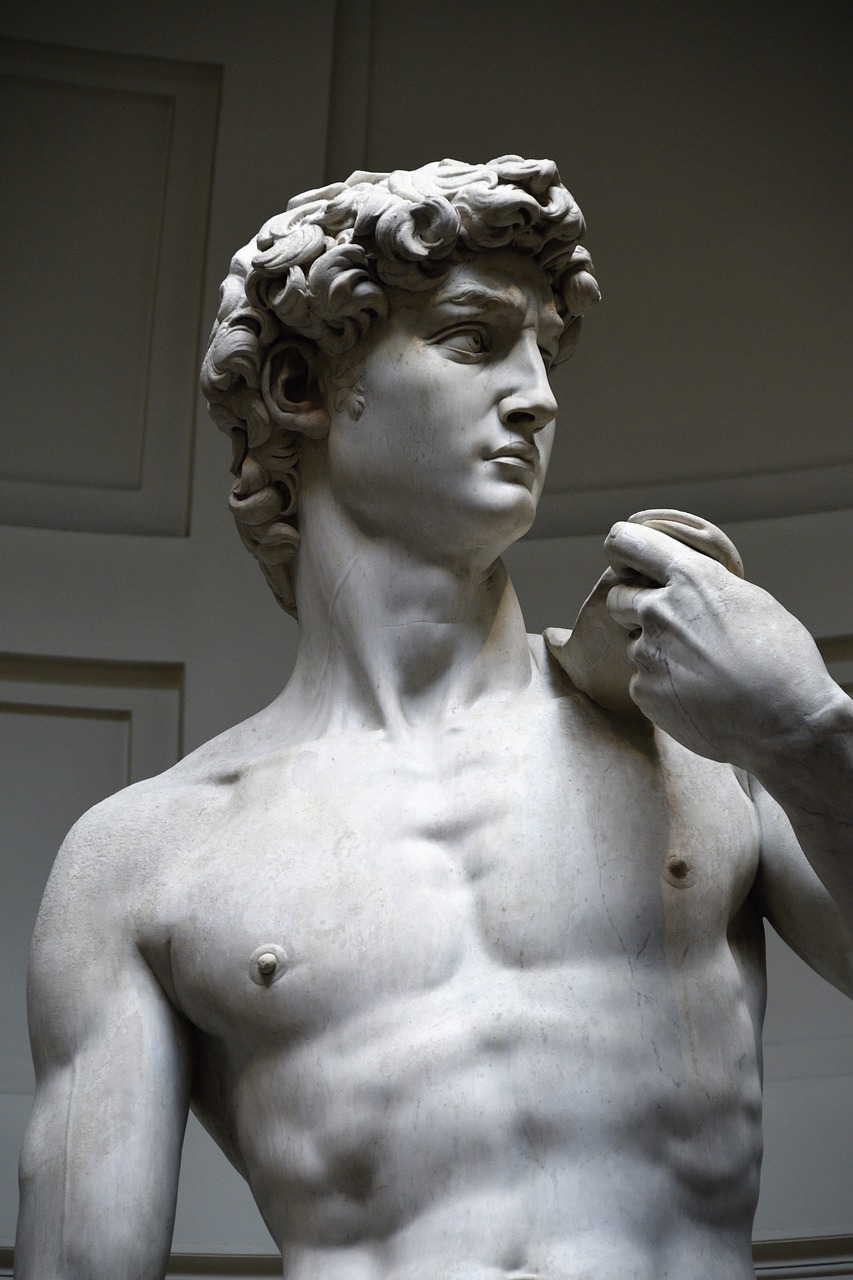
However, you cannot say that the statue of David, by Michelangelo, and a heap of garbage are the same things. The aesthetic is transcendental. Meaning that it does not come from experience (empirical) but from the nature of human consciousness itself (a priori). The beauty and pleasure become a source of suffering only with desire. When I need this to be happy.
Michelangelo, despite his magnificent accomplishments, was a very humble and simple person inspired by the virtue of art. In contrast to his contemporary Raphael, who used is talents to gain fame, fortune, and admiration.
The classical virtues are transcendent. When they are desired for their sake, they bring an otherworldly satisfaction.
The mind that is constantly chasing sensory pleasures, existing between excitement and boredom, success or failure, knows no peace.
Conclusion
Human awareness is unconditioned. It only becomes troubled when it gets involved with the world, chasing and becoming what it can never be. True happiness comes from a simplicity and peacefulness of mind. It is like the pure awareness of a young child, existing with simple acceptance, without needing to possess or to prove anything:
Consciousness is a plenum of existence and this determining of itself by itself is an essential characteristic. (Being and Nothingness).